Hold Music
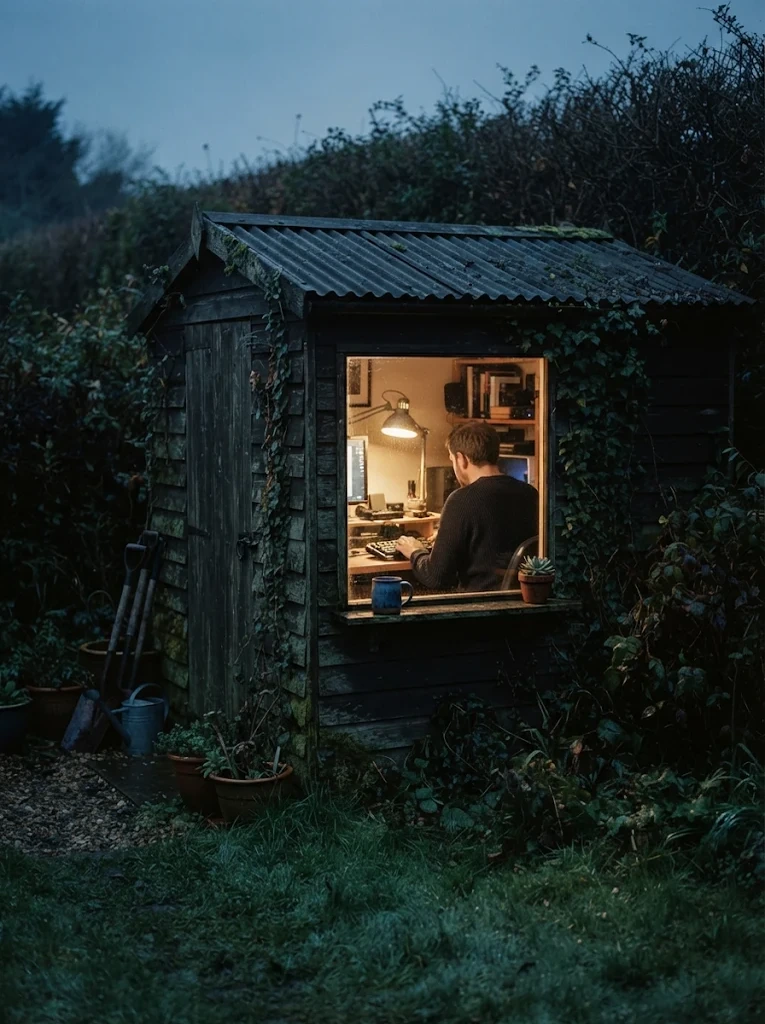
In October I wrote four minutes of music for a funeral director in Glenrothes. It was for their telephone system. The brief said: no top line, no vocal, nothing that resolves.
The shed is three metres by four and a half and it smells of the inside of a guitar case. There is a fan that turns, a stool with a split seat, and a noticeboard where I pin the year's work, one sheet to a job, so I can see what the year has been. The window looks at a hedge, and past the hedge at the back of a caravan that somebody has been meaning to move since before I moved here. The kettle is on the floor by the door because there is nowhere else for it.
I am forty-four. I write library music, which means small pieces that other people put under things: under adverts, under corporate video, under the menu screen of a golf club's booking line, under the thirty seconds before a podcast starts. Eighty-seven cues in the Waverley Rights catalogue. My best year was £11,400 gross. I drive a Berlingo with a clutch that slips when it is cold, and I swim at the leisure centre in Kirkcaldy on a Tuesday because the water is warmer than the sea and the membership is £22 a month.
Waverley take forty per cent. Sandra Fyfe runs the catalogue. She is good at it and she has never once pretended the money was better than it is.
In 2018 they asked for an album of beds for corporate and care settings. Twelve pieces, no percussion, nothing that draws attention to itself. Track seven was mine. Three minutes fourteen. I called it Seabank, after the bench at the bottom of my mother's road, and I wrote it in an afternoon and I was pleased with it in the way you are pleased with a shelf that turns out level.
I have always timed things. The walk to the shop is six minutes. The kettle is a minute forty. It is not a joke; it is just what I do instead of thinking.
A piece like Seabank has no ending. You write sixteen bars that come back to where they started and you stop, and if you have done it right the join is not audible. It does not finish. It starts again. A tune that resolves is a tune that asks you to listen to it, and nobody on a telephone wants to listen to it.
In the March of 2021 Waverley licensed it to Forth Water for their telephony. Four hundred pounds, buyout, and a Schedule 4 that Sandra dealt with. My share was two hundred and forty and I remember being pleased.
The quarter after that, money came in. The bank said FORTH WATER SCH4 and I took it for usage, because that is what usage looks like. It came every quarter and it got bigger. I opened the first statement, saw a table on it, and put it in the shoebox with the others. In 2022 Wilma, who does my accounts, asked me what the Forth Water line was and I said usage, and she wrote usage in the box, and that was the end of it.
On the Sunday I drove over to Buckhaven and took my mother to the Aldi in Leven. She is seventy-seven and will not use the self-checkouts. They're no' getting my labour for nothing, she says, and stands in the queue with a basket while the girl on the till puts through a family shop. Then we drove back, and I carried the bags up, and she made tea, and we sat in the front room with the sea two streets off and not visible.
She has a new boiler. I paid for it in the March after, out of the Waverley money, and she let me, which was its own event. It sits in the kitchen in a white jacket with a digital display and a service tag hanging off the pipe, and she keeps the tag because the man wrote the date on it.
There was a letter under the biscuit tin on the telephone table, and I read the top of it while she was in the kitchen. Forth Water. No further action. I put it back.
She came in with the tea and said she had been on to the council about the bins.
"Twenty minutes," she said. "Twenty minutes to tell a machine I've no' got the right bin."
"Did you get somebody?"
"I got a boy who said it was a different department." She sat down. "I heard your tune."
"Did you."
"On the water board's. I was on about the bill in the summer and there it was, going round and round." She turned her cup. "It never gets anywhere, does it."
"That's the idea," I said.
"Aye, well," she said.
• • •
The voicemail came on the Wednesday, ten past eight in the morning, from a payphone. My phone logs a payphone as no number at all. I was in the shed with the fan on and I played it four times before I wrote it down.
"Mr Cochrane. My name is Margaret Tait. I live in Methil. I'm no' wanting anything from you." The pips went. "My house was flooded in the November. I was on their phone for the length of a programme. I asked the girl for the name of the music and she told me, and I've had it on a bit of paper since. I found your number on the internet and I'm sorry to be calling you at your home." The pips again. "I'm asking you to take it off. That's all I'm asking. Thank you."
Forty-one seconds.
There are four M. Taits in Methil and none of them answered. I wrote a letter and did not send it, because there was nowhere to send it, and because I did not know what I would put in it. I played the message again. She had said the length of a programme. I worked out that a programme is an hour and decided she had been kind.
• • •
I phoned Forth Water on the Thursday from the shed. The line rang twice and a woman said calls were recorded and asked which service I wanted. Claims was one. Then it played.
It is a strange thing to hear your own piano come down a telephone. The compression takes the top off it and puts a pulse on the bass I did not write. I sat with the phone against my ear and counted. The second time through, the low strings came in at the wrong place, and I heard it, and nobody else in the world has ever heard it. The third time through I could hear the join. A click. It is not on the master. It is the system.
At nine minutes and something a woman said, "Forth Water, Nessa speaking, can I take your reference?"
"I don't have one."
"Everybody's got one."
"I'm the composer," I said. "Of the music."
A pause with typing in it.
"Right," she said. "You're E. Cochrane."
"Yes."
"It's on the admin page. Author of record, Waverley Rights, E. Cochrane. I've been looking at that for four years."
"I'm trying to get it taken off."
"Why?"
"Because a woman phoned me from a payphone in Methil and asked me to."
"Margaret Tait," she said.
I did not say anything.
"I'm no' supposed to know that. She phoned us twice and she wrote in. It went round the team." A chair moved. "Mr Cochrane, I've heard your tune nine hundred and something times. I could tell the time by it. There's a bit at nine minutes where the piano comes back and I know it's the fourth time round, and I know most of them are going to go before I ever get to them. Eleven minutes forty. That's the mean to abandonment. It's on a graph on my dashboard."
"And that's good."
"It's in band. The band's nine to thirteen. The one before yours was six fifty-two and the complaints went up. People phoning back angry. People writing to their MSP." She breathed out. "I'm no' supposed to give out the figures. I'm having a bad week. What are you wanting me to do?"
"Take it off."
"I answer the phone," she said. "I'll give you the licensing address. That's what I can do."
She gave me an email address and I wrote it on the back of an invoice. Then she said, "If you write to them, don't say you spoke to me."
"Why not?"
"Because I've a quality score," she said, "and you'd be a non-compliant interaction."
I laughed. She did not.
I asked her to pass on my number to Mrs Tait. She said she would. I do not know whether she did.
• • •
I wrote to the licensing address on the Friday. Rachel Dunlop replied on the Monday. Her title was Customer Experience Lead and her email had three logos in the footer.
"Dear Mr Cochrane, Thank you for your email. I've attached the licence and the associated schedules. I'm sorry you were contacted directly; that isn't how we would want this handled. I'd be glad to talk it through. Kind regards."
The licence was eleven pages. Page seven was Schedule 4.
> 4.3 The Licensee shall pay to the Author of Record, quarterly in arrears, a share of the Efficiency Saving calculated in accordance with Appendix B. > > 4.4 The Efficiency Saving is calculated by reference to the number of calls which are resolved without the intervention of an adviser, being calls classified in the Licensee's reporting as self-resolved.
Schedule 1, definitions:
> "System" means the Licensee's automated call distribution and interactive voice response platform, together with any replacement, upgrade or successor system.
Clause 9:
> 9.1 The Licence shall subsist for the life of the System. > > 9.2 The Licence is irrevocable save for material breach by the Licensee.
I read it twice. Then I read Appendix B, which is a table with a worked example at the top, and the worked example has my name in the first row.
I phoned Rachel on the Tuesday.
"We're not doing anything to them, Mr Cochrane," she said. "We're playing them a tune."
"Eleven minutes forty."
"Where did you get that?"
"Your own dashboard."
"That's an internal figure." A pause. "It's a good figure. We've been in band every quarter since we licensed it."
"Because it never resolves."
"Because it holds," she said. "I'm not a musicologist. The trial report says it holds attention without rewarding it. That's the phrase they used. The one before went at six fifty-two and we had a spike in complaints. Yours doesn't make anybody angry. They just go."
"Where do they go?"
"Home," she said. "They fix it themselves, or they don't fix it. I don't know. I'm not being smart with you. I don't know."
"Then take it off."
"I can't. The licence is with Waverley. We license from them."
"It's my tune."
"It's their recording," she said. "And it's our system, and the system's what the licence is for." She was quiet for a moment. "Mr Cochrane, I've a queue. If it helps, nobody here knows your name. It's a line on a page. You're a line on a page."
"That doesn't help."
"No," she said. "I didnae think it would."
That weekend I wrote a new one. Same key, same tempo, same piano, and at three minutes it comes down onto the home chord and stops, the way a piece is meant to. I sent it to her on the Sunday night and said they could have it for nothing, and that it was mine to give.
She replied on the Thursday.
"Dear Mr Cochrane, Thank you for the new piece. We ran it on the test rig on Tuesday. The mean to self-resolution was 7:10, which is below the band. The trial report says it resolves, which tells the customer the call is nearly over, and then they get angry when it isn't. I'm sorry. It's a nicer piece than the other one. That's the trouble with it. Kind regards."
• • •
Sandra took my call on the Wednesday.
"I've read the licence," I said.
"Then you'll know."
"The term is the life of the system."
"Aye."
"How long is that?"
"How long is what? The machine?"
"The machine."
"Ewan. Read the definition again."
"Together with any replacement, upgrade or successor system."
"Aye."
"So it's not a machine."
"It's the function," Sandra said. "As long as they've got a phone line and a queue, the licence is alive. It's standard in utilities. It's the only way they'll take a bed. They're no' going to re-license the same tune every three years for four hundred pounds."
"And the participation?"
"That's yours. That's not ours. That's the author's share."
"How much has it been?"
"Six thousand four hundred and something since 2021." A keyboard. "You paid for your mum's boiler out of it. You told me at the Christmas night out."
I had.
"I'd like to stop it," I said.
"I can stop paying you. It'll accrue."
"Where?"
"A suspense account. It doesnae go away. It's not a tap, Ewan. It's a calculation."
"Then I'll breach it."
"You can breach it. They'll stop using it and sue us, and we'll pass it to you, and you've got a van and a shed." She let that sit. "You're not the first person to phone me about a licence. You're the first one that's read it."
I asked her whether she had known.
"I knew it was a utility licence with a performance schedule. I didnae know it was your mum's water."
• • •
I read on a consumer website that you can ask for everything a company holds about you. I wrote to Forth Water and asked. Twenty-nine days later a PDF arrived. The covering letter was one paragraph and the PDF was sixty pages: the licence, the schedules, and four years of quarterly reports, each with the same header.
> Schedule 4 — Quarterly Performance Report. Author of Record: E. Cochrane. Track: Seabank (Waverley Rights). Mean time to self-resolution: 11:40. Fourth-pass retention: 61%. Complaints per 1,000: 0.4. Efficiency Share: £612.40.
Each report had a figure in it for the percentage of calls self-resolved, and there were sixteen of them, one for every quarter, going up and up. I read all sixteen and then I went out to the shed and sat down and did not turn anything on.
I found the case study the next day. It was on the website of a company in Reading that made the phone system, and the headline was "Forth Water: 31% reduction in avoidable contact". There was a photograph of a call centre in Livingston and a graph with no numbers on it. My name was in the second paragraph.
For a fortnight I noticed the tune everywhere. I phoned my bank and their hold music had a saxophone in it and I put the phone down after two minutes.
The envelope from Nessa came on the Friday. A4, printed, no covering note, just a compliments slip with as requested in biro. It was a table of references, no names. Date, time, duration, outcome. Eleven hundred rows, the week of the fourteenth of November. Nine hundred and forty of them self-resolved. Calls over thirty minutes were in a short table at the end, longest last.
The last of them was the fourteenth of November, 20:04, 38:19, self-resolved, no callback requested, FB-24-11417.
Margaret Tait was somewhere in the eleven hundred. I would never know which row was hers. I sat with the two pages for a while. Then I got the van keys.
• • •
The letter was still under the biscuit tin. She was watching the racing with the sound down.
"Can I see that?" I said.
"The water board."
"Aye."
She passed it over. It was two pages, the second one mostly small print, and the date at the top was the second of December a year ago. There was a table at the top of the first page, under the reference and her name and the address of the property, and the table was headed Contact history, and it had one row in it.
"I'd like to read this to you," I said.
"I've read it."
"Your eyes."
"I've read it," she said, and then, "Go on then."
I read it out. The date of the attendance. The finding: no defect in the adopted asset. The ingress originated within the curtilage. No further action, no payment, and the line about the Ombudsman within six months. Then the table. The fourteenth of November, 20:04, thirty-eight minutes, call ended before an adviser could assist.
She had her hands in her lap. The racing went round.
"Thirty-eight minutes," I said.
"I'd other things to be doing."
"You didnae say."
"It's a pipe," she said. "It's a pipe in a kitchen. You'd have come over and taken the skirting off and it'd have been a fortnight."
"I'd have come over."
"I know," she said. "That's why I didnae say."
She took the letter back and folded it and put it under the tin, and the tin was between us on the table with the good scissors and the rent book.
"Where did the money come from for that boiler?" she said.
She did not look at me when she said it.
"Work," I said.
"Aye," she said.
Behind me the heating came on. It was set for half four and it was never late. The boiler lit with a noise like a door closing in another room. She turned the radio on for the news, and under the advert in front of the news there were four notes.
She hummed them, and lifted her tea.

