Reasonable Adjustments
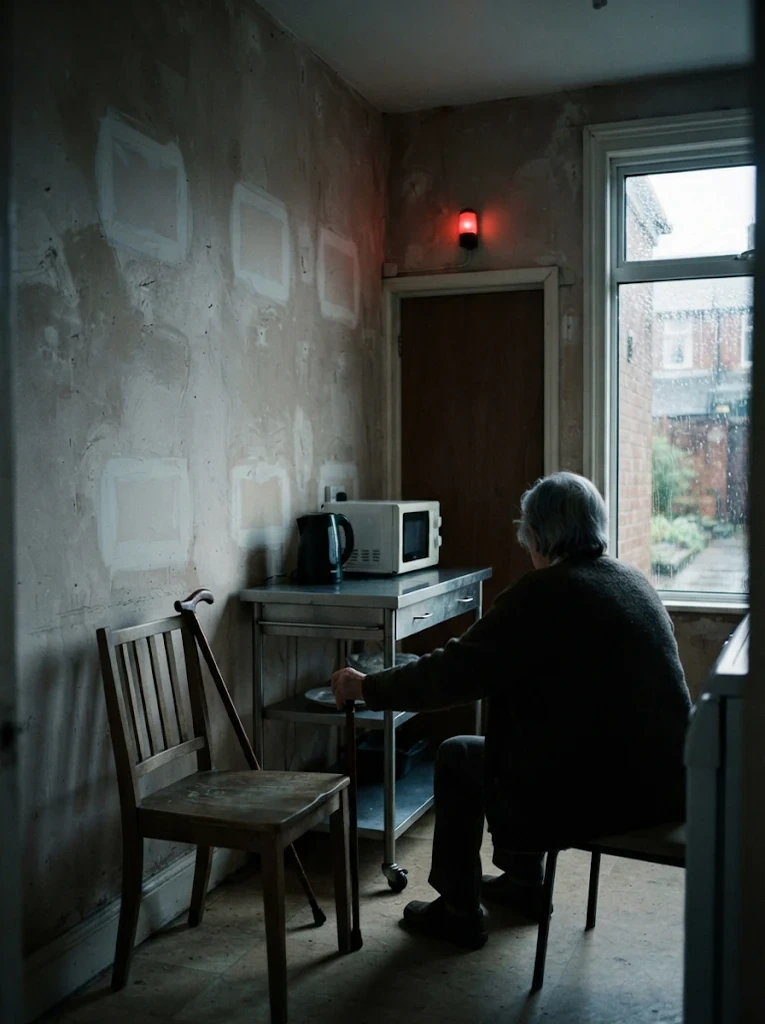
They came on a Tuesday in March, three of them, and the first thing the young one did was put a tape across the living-room doorway and read out the number.
"Seventy-six."
"Seventy-six because that's what the yard had that week," I said. "I hung that frame."
He wrote it down. The woman wrote it down too, in a box on a form, and underlined it. She had been in the job six weeks. You could tell, because she still wrote in full sentences.
Her name was Ola. She sat on the arm of the chair, because there was nowhere else to sit, and asked me the questions in the order they came. Could I manage the bath. Could I manage the front step. How many times a week did I go out. Did I cook. Did I wash. Had I fallen.
"I fell in January," I said. "In the hall. Between the bedroom door and the coat hooks."
"And you got yourself up."
"I did."
She wrote that down. She had a way of writing things that made them sound like a result.
The reason she was there at all was Sarah. Sarah is my daughter, she's thirty-three, she's a radiographer in Leeds, and she rang the council in the February because I'd fallen in the January and lain in the hall an hour and a half before I got myself up. I never told her about the hour and a half. She knew anyway. She has a little boy and a spare room and a bus route, and she wants me in it, and from a hundred and ninety miles away the only thing she can do is ring the council.
So the council came.
The letter had come in the February, from a team called Independent Living Optimisation, Room 4.12, Civic Centre. It gave a date and a time and a name. The form had ILO/1 in the corner.
I bought the flat in 1994. Right to buy, thirty-eight and a half, ground floor, because Jackie's mum couldn't do stairs and the council wouldn't move her. Two bedrooms, a kitchen at the back, a bathroom off the hall, a garden the size of a van. I did the kitchen myself, in a fortnight, after the shop shut. I hung the doors. I put the studs in the bathroom wall before I knew what they were for. Jackie died in 2020. She went into Whipps on the Tuesday and didn't come out, and the kitchen was still the colour she'd painted it.
"We're not talking about a grant," Ola said. "It's the little things. Reasonable adjustments."
"It works," I said.
"You've got a stick."
"The stick works."
She looked at the form. "Anything we do now is temporary. We review at eight weeks."
"Temporary how?"
"It means we can take it out again."
"Take what out?"
"Whatever we put in."
The young one had a bolster against the wall and a lump hammer in his hand. Ray was about my age, with the same knees, and he ran his thumb along the architrave I'd mitred in 1994 and said, "You did these, Martin."
"I did."
"They don't mitre like this now."
"They don't."
The wall came out in half an hour. Ninety by the end of the day, and a length of plastic trim round the opening where the timber had been.
"They go in the skip," the young one said, meaning the architraves.
"Leave them," Ray said. "He wants them."
I carried them out to the shed and stood them in the corner by the bench. Ash, two lengths, eight foot, the mitres still tight.
The rail came off the bathroom wall the same afternoon. Ash, two foot six, screwed into the studs I'd put in for Jackie's mum when her knees went, used by her for four years, and by Jackie for the last two, and by me since, on the bad mornings. The leg's the best leg I've got. It's not the leg. It's the message. The message doesn't get there.
"Not to regs," Ray said.
"It was to hers."
"It's going in the skip."
"I'll have it."
He looked at me. "They'll bring a steel one."
"Then they'll bring a steel one."
The steel one came on the Friday, with a man from a different firm, who also fitted a grey box above the front door. The size of a fag packet. Two screws into the frame and a red light on it.
"What's that for?"
"It's a door counter."
"Counts what?"
"The door."
"The door opens when it opens."
"It's so we can see how you're managing."
"It's a door," I said.
Ola was there. She said, "It saves you having to tell me things you'd rather not."
"Who's paying for it?"
"It comes out of your personal budget," Ola said. "It doesn't cost you anything."
"That's my money."
"It's the council's money."
"It's my budget."
She wrote something else down.
I keep a book. I've kept one since 1989. Date, address, job, materials, price. The first entry is a shopfit in Wood Green, nine days, one and a half, and I was twenty-one and thought I'd be doing it forever. The book's got the last twenty years in it. A kitchen in Hornchurch. A stair rail in Chingford. A shop in Ilford with a counter I made out of a single piece of oak because the man's wife liked the grain.
The day the doorway was done I wrote: 18 March. Doorway, living room. Borough. Temporary, underlined twice. Under price I put nil.
Ray said, before he went, "They've took on six jobs and no fitters. Attrition, they call it."
"Attrition," I said.
"It means they don't replace you."
• • •
The review of the first works was set for the fourteenth of May. The letter for the second lot came on the ninth, with the bathroom booked for the twelfth.
I rang the number. A woman asked for my reference and I gave her the reference, and I said, "The review's the fourteenth. The works are the twelfth."
"The works aren't affected by the review, Mr Wilding."
"But the review's after."
"The review doesn't affect the works schedule."
I put the phone down. There wasn't anything else in it.
The letter about the budget came the same week. Your personal budget has been recalculated to reflect unmet needs avoided. I read it four times and put it in the drawer with the others.
The bathroom took four days. The bath came out on the Wednesday and I washed at the kitchen sink, and on the Sunday there was a wet room: a drain in the floor, a plastic chair, a steel rail the same length as the ash one, a curtain on a track.
The agency rang on the Monday. My calls went from seven a week to four.
Rosa does Tuesdays and Fridays. She's fifty-one, she's from the Philippines, she's been doing it eighteen years, and she doesn't hurry. She does my back and my feet and she makes me a cup of tea and she tells me about her son, who is doing a course in mechanical engineering at a college in Romford, and she says the word "mechanical" like it's a hymn.
"They told me the wet room does it now," she said.
"The wet room doesn't talk," I said.
She laughed.
In the hall, the freeholder's notice had come unstuck at one corner and curled inwards. External decoration and roof renewal, programmed 2031. It had been up since before Jackie died. Someone had written "ha" next to the date in biro.
I did Eileen's door in the May. Upstairs, front door, twenty minutes with the block plane and a bit of candle, because it swells and sticks. She gave me twenty quid and a jar of marmalade she makes herself.
"You're the only man in this block who can do anything," she said.
"I'm the only man in this block," I said.
• • •
The kitchen came out in the July.
The units were 1994 and solid, and the doors were the ones I'd hung, and Jackie had painted them twice, the second time a colour she called putty and I called grey. The sink was capped. The hob went. The wall units came down and left six pale rectangles on the plaster, and one rectangle lower down, under the window, where the shelf had been.
Inside the cupboard door next to the sink, on the back, she'd written the fuse box in pencil: KITCHEN SOCKETS, IMMERSION, LIGHTS. She'd done it standing on a chair with the door across her knees. The pencil had gone grey with the years and you had to tilt it to the light.
The man from the contractor had the doors in a stack by the back door. "You won't want these."
"I'll have that one."
"Which?"
"That one."
He looked at it. "It's got writing on it."
"I know."
I carried it out to the shed and stood it behind the architraves. There was room then.
What was left of the kitchen was a stainless trolley, two shelves, four castors, one of which pulled to the left. Kettle on top, microwave underneath. A plug in the wall for the kettle, and between the plug and the kettle a white adaptor the size of a matchbox, with a light on it.
"That's so we can see you're making something," Ola said.
"It tells you when I boil the kettle."
"Yes."
"Why?"
"So you don't have to tell me."
"I don't mind telling you."
"A lot of people do."
I boil it for the bottle. The hot water bottle goes across the top of the leg at night, and it's the only thing that gets me past four o'clock. Nine times a day, ten, the kettle goes on, and the light on the adaptor comes on with it, and somewhere a line goes up.
I wrote in the book: 9 July. Kitchen. Borough. Temporary. Nil.
• • •
The scooter came in the September. Four wheels, second-hand, four miles an hour, which is slower than walking except I can't walk that far. I take it up the alley to the library on the Tuesday, which is ninety per cent of why I wanted it. The librarian saves me the crossword. It has to charge indoors. The only indoors with a floor and a socket was the shed, because the flat has no room and the hall has no socket and the wet room has a drain in the floor.
The shed is eight foot by six, at the end of the garden, an asbestos roof and a bench I made out of a fire door. Ray took the bench out in two pieces. He took the vice off it and the vice came off easily, because I'd greased the thread every year since 1991.
Ray gave me a hundred and fifty for the tools. The router, the two saws, the chisels in the roll, the Stanley 78, the plane that was my father's and never a good one. He knew what it was worth and he didn't pretend otherwise, and I liked him for it.
"I can't do more," he said.
"It's fine."
"These are good tools."
"They've done some work."
He put them in the van. I kept the block plane, because it was blunt and he didn't want it, and because Eileen's door would want doing again.
The scooter goes where the bench was. Behind it, under a dust sheet, are the two architraves, the ash rail and the cupboard door with Jackie's writing on the back.
I did Eileen's door again in the November with the blunt block plane. It took me two days and I had to sit on the stairs after. She gave me twenty quid and the marmalade.
"You'll do it next year," she said.
"I'll do it next year."
• • •
Ola came on a Thursday at the end of November with the review in a plastic wallet. She'd been in the job ten months. She didn't write in full sentences any more.
The rain was going on the window and the trolley had a wheel that squeaked, and I'd been meaning to see to it. The bed was in the front room now, because it's nine steps to the wet room from there instead of nineteen, and at three in the morning nineteen is a long way.
She'd had her hair cut since the summer. She sat on the chair with the form out of the wallet and the tablet on her knee.
"Right," she said. "The review. Are you sitting comfortably?"
"I'm always sitting comfortably."
She read it out. Mobility, met. Nutrition, met. Personal care, met. Social contact, met. Equipment, met. Housing, met.
"Housing," I said.
"The flat's adapted."
"The flat's empty."
"Met," she said, and went on.
Page one had a section called Readings. Exits per week: four. Hot drinks per day: nine.
"Four," I said. "I go out the back."
"The back door doesn't have a counter."
"So it's wrong."
"It's a guide."
"Nine hot drinks. That's the bottle."
"It doesn't know what's in the cup."
When she got to the end she sat back. "There's nothing outstanding. That's a good report."
"What would a bad one look like?"
"Something unmet."
"And then what?"
"And then I'd put in for something." She said it like it was a good thing, and it was.
"When did you last come out?"
"July. For the kitchen."
"You've not been out since July."
"The reviews I do from the readings."
"The kettle," I said.
"And the door. It saves you—"
"Telling you."
Page two was the property bit. She said I didn't need to bother with it, it was just the system, and she left it on the table while she went to make the tea.
I read it upside down. I've read drawings upside down my whole life; you do it across a bench. It said:
Asset: FH-14. Reasonable adjustments to date: 5. Unmet need: nil. Vacant possession: achievable by attrition. Programme year: 2031.
The signature box was at the bottom of page two, under the property bit.
"What's attrition?" I said, when she came back with the two cups.
She put the cups down. "It's when a tenancy ends without a decision being made. A move, or a—" She stopped, and started again. "It's a property term."
"Whose decision is it?"
"It isn't a decision. It's a programme."
"Whose programme?"
"The asset team's."
"Am I on it?"
"Your flat is."
"There's a difference."
"There is," she said, and looked at the form.
"Two thousand and thirty-one," I said. "I'll be sixty-three."
"It's a long way off."
"It's five years."
She didn't say anything to that.
"Once the review's signed," she said, "the agency package gets looked at again. The Tuesday call can probably come out. The wet room's done, you're managing the washing."
"Rosa does the shopping list with me."
"We can get your shopping delivered."
"She does it with me."
Ola wrote something on the form. "If your needs change, we reassess."
"They have."
She looked up.
"Not the washing," I said.
She held the pen a second. Then she said, "I can refer you to the wellbeing service. They do a Thursday group at the library."
"Right," I said.
"Shall I put it down as a referral?"
"Put it down."
She wrote it down. I never heard from the wellbeing service.
"If you could just sign at the bottom," she said, and turned the form round and put the pen on it.
"What happens if I don't?"
"The review stays open."
"And then?"
"And then it stays open."
I signed it. My hand's not what it was. It came out small.
"Can you take that box off the door?" I said.
"The counter?"
"It counts me."
"It's the contractor's. I can raise it."
"Will you?"
"I'll raise it."
She put the tablet in the bag and the form in the wallet and her coat on. At the door she said, "You've done really well. Most people don't engage with it at all."
Then she was gone, and the rain was going on the window, and the red light over the door was on because she'd opened it, and it went off when she shut it.
• • •
I got the cupboard door out from behind the scooter and carried it down the garden. It's not heavy. It's chipboard with a veneer. It had her writing on the back in pencil.
I stood it against the bin store wall with the ash rail, which still had the screws in it. It was raining on them. The bin men came on the Thursday.
I went back in and the light came on.
I got the book out of the drawer and opened it at the next clean line and wrote: 26 November. Flat. Vacant possession, attrition, 2031.
Under price I put nil.

